

Get a feel
for blending.
Three nearby colors. A few overlapping strokes. Start small, and watch what each pass changes.
Open a practice space ↗Pick light, middle and deep.
Choose three colors in the same family with a visible step in lightness. This keeps the first study focused on transitions. Once it feels familiar, move sideways into a neighboring hue.
The studio’s wheel and blend suggestions help you explore those relationships. Treat suggestions as starting points: similar-looking screen swatches don’t guarantee the same result on paper.
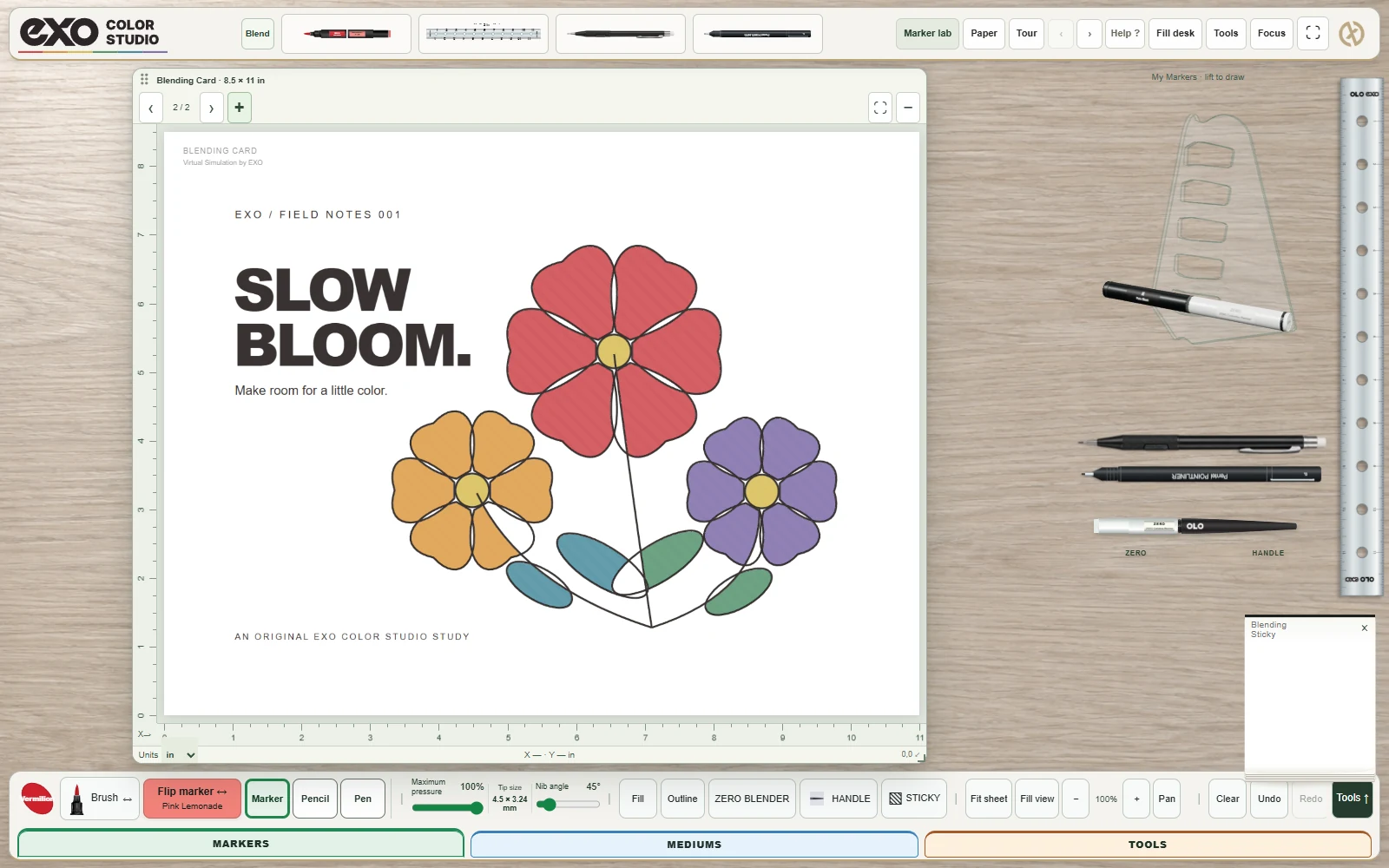 Open an actual studio study and try your own layers over the imported outline.
Lay color. Cross the edge.
Draw a short patch with the light color, then overlap part of it with the middle color. Add the deepest color along one edge. Leave enough of each original mark visible to compare the transitions.
Use a brush to explore changing width, or a chisel for a broad, controlled band. In the studio, supported stylus pressure and repeated passes change the digital stroke.
Work the join gently.
Return with the lighter marker and make a few short passes across the join. Compare one pass with several. Use a separate practice card to test rather than repeatedly working the same part of your main artwork.
With OLO selected, try ZERO across a colored boundary and onto an empty area. Its digital solvent response redistributes pigment and carries some tint; it is not a white paint or a clean eraser.
Explore OLO and ZERO →Keep the useful combinations.
Save the markers you like to your collection. Connect your EXOLOX account to keep your marker choices, preferences and saved studies available when you return on another device.
When you move to a real project, test on an offcut of the actual material. Paper, ink, drying time and light all affect the result. The digital study is a useful exploration, not a measured formula for a physical blend.
Make it your studio ↗